 5th Floor, Plot No.7, IT Park, Sector-22 Panchkula, Haryana-134109
 info@farlex.in
 +91-98759 98089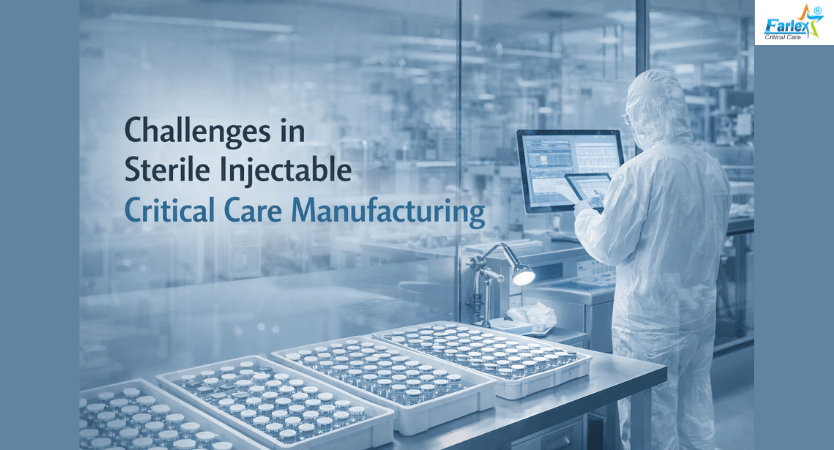
20th April 2026 | By Admin
Manufacturing Challenges in Sterile Injectable Critical Care Products
Sterile
injectable medicines play a central role in critical care because they are used
in situations where speed, precision, and reliability are essential. Unlike
many routine formulations, sterile injectables demand highly controlled
production environments, validated processes, and constant quality oversight.
For organizations evaluating liquid injectable range manufacturers in India,
it is important to understand that sterile production is not simply about
filling vials. It is a complex manufacturing discipline where every stage must
be carefully managed to protect product quality and patient safety.
This is
one reason why experienced companies in this segment invest heavily in
technical infrastructure, quality systems, and skilled production teams. A
dependable critical care pharmaceutical company in India is expected to
handle the challenges of sterile injectable manufacturing with consistency,
process control, and regulatory discipline.
Why Sterile Injectable Manufacturing Is More Demanding
Sterile
critical care products are often used in emergency care, intensive care,
anti-infective therapy, and hospital-based treatment protocols. Because these
products bypass many of the body’s natural defenses, they require an extremely
high standard of sterility assurance.
The
manufacturing challenges become greater when products are sensitive to:
- contamination risks
- temperature variation
- moisture exposure
- particulate matter
- dosage precision
requirements
That is
why companies recognized among the best lyophilized injection manufacturers
in India or advanced sterile injectable producers follow much stricter controls
than general pharmaceutical facilities.
Challenge 1: Maintaining Sterile Production Conditions
One of
the biggest challenges in sterile injectable manufacturing is maintaining
cleanroom integrity throughout production.
Sterile
areas must be carefully controlled for:
- air quality
- microbial load
- differential pressure
- temperature
- humidity
Even a
small deviation can create a serious risk for product contamination. This is
especially important for a critical care pharmaceutical company in India
that supplies products intended for hospital and intensive care use, where
product reliability is directly linked to clinical performance.
To manage
this challenge, manufacturers invest in:
- classified cleanrooms
- HEPA filtration systems
- environmental monitoring
programs
- personnel gowning discipline
- validated sanitation
procedures
Challenge 2: Aseptic Processing Control
Aseptic
filling is one of the most sensitive stages in sterile injectable production.
Once the formulation is prepared, every transfer, filling, sealing, and
handling step must be performed under strictly controlled aseptic conditions.
This
challenge becomes even more significant for liquid injectable range
manufacturers in India, because liquid products can be highly sensitive to
environmental exposure. Any process weakness during aseptic filling can
compromise batch quality.
To reduce
this risk, manufacturers use:
- validated aseptic filling
lines
- media fill studies
- operator training and
qualification
- routine intervention control
- line clearance procedures
Strong
aseptic discipline is often one of the clearest indicators of a technically
mature manufacturer.
Challenge 3: Equipment Validation and Process Reliability
Sterile
injectable manufacturing depends heavily on equipment performance. Mixing
systems, filtration units, filling machines, sterilization systems, and sealing
equipment must all work with repeatable accuracy.
A company
known among the best lyophilized injection manufacturers in India is not
judged only by installed machinery, but by how well that machinery is
validated, maintained, and monitored.
Common
equipment-related challenges include:
- calibration drift
- filling accuracy variation
- filter integrity issues
- sterilization cycle
deviations
- mechanical downtime
affecting process flow
Manufacturers
overcome these risks through preventive maintenance, validation protocols,
qualification studies, and documented control systems that support consistent
production performance.
Challenge 4: Product Stability and Moisture Sensitivity
Many
critical care injectables are highly sensitive to environmental factors. Some
products remain in liquid form, while others require lyophilization to improve
stability and shelf life.
For liquid
injectable range manufacturers in India, formulation stability is a
constant challenge because liquid systems may react differently under storage,
transportation, or hospital handling conditions. Likewise, for manufacturers
handling lyophilized products, residual moisture control becomes a critical
quality factor.
This is
why a capable critical care pharmaceutical company in India must support
sterile manufacturing with:
- formulation stability
studies
- container closure integrity
checks
- compatibility evaluations
- packaging validation
- storage condition assessment
These
steps help ensure that the product remains safe and effective throughout its
intended shelf life.
Challenge 5: Particulate and Visual Control
Sterile
injectable products must be free from visible and non-visible particulates.
This requirement is especially important in critical care because injectable
products are administered directly and often used in clinically sensitive
situations.
Maintaining
visual and particulate quality is one of the practical challenges that
separates disciplined manufacturers from average production facilities.
Manufacturers
typically address this through:
- filtered formulation systems
- controlled material transfer
- automated and manual visual
inspection
- container handling controls
- particulate testing during
quality review
Both liquid
injectable range manufacturers in India and companies known among the best
lyophilized injection manufacturers in India are expected to maintain
robust inspection practices for every production batch.
Challenge 6: Skilled Personnel and Human Error Prevention
In
sterile manufacturing, people are one of the strongest assets and one of the
highest-risk variables. Even with advanced equipment, human error in gowning,
handling, documentation, or interventions can affect batch quality.
This is
why every serious critical care pharmaceutical company in India invests
in:
- technical training
- aseptic behavior qualification
- periodic retraining
- supervision systems
- deviation review culture
The goal
is not just to operate equipment, but to build a manufacturing culture where
every team member understands the importance of sterile discipline.
Challenge 7: Documentation, Traceability, and Regulatory Readiness
Sterile
injectable production must be fully documented. Every material, machine,
process step, environmental reading, and quality test must be traceable.
This
level of documentation helps manufacturers:
- investigate deviations
- maintain reproducibility
- support audits
- strengthen batch release
decisions
- build regulatory confidence
For
organizations evaluating liquid injectable range manufacturers in India,
documentation quality often reveals whether a company truly operates with
manufacturing maturity or only with commercial intent.
Why These Challenges Matter in Critical Care
In
critical care manufacturing, production challenges are not abstract technical
issues. They directly affect product consistency, hospital confidence, and
long-term association value.
A
manufacturer that can manage sterile injectable challenges effectively is far
better positioned to support:
- stable product supply
- reliable batch quality
- better process repeatability
- hospital-oriented
manufacturing expectations
That is
why businesses often look beyond product listings and focus on how a critical
care pharmaceutical company in India handles sterile production capability
in real working conditions.
Conclusion
Sterile
injectable manufacturing in critical care is one of the most demanding areas of
pharmaceutical production. It requires far more than equipment and product
availability. It demands cleanroom discipline, aseptic control, validation
strength, stability understanding, particulate management, trained personnel,
and documentation accuracy.
For
companies evaluating liquid injectable range manufacturers in India,
these manufacturing challenges provide a practical framework for identifying
genuine capability. Likewise, organizations looking at the best lyophilized
injection manufacturers in India or a reliable critical care
pharmaceutical company in India should always assess how well sterile
manufacturing challenges are managed over time.
In critical care, manufacturing strength is not defined by claims. It is defined by process control, quality discipline, and the ability to deliver sterile products with consistency and responsibility.